


Claims about localization hiring often contradict each other. Linguists and managers are supposedly losing their jobs to AI, while quality and vendor management are the safe human jobs. Newcomers hear that they need localization experience, while experienced practitioners worry that outsiders are taking the jobs. Then there’s the advice to learn to code or leave, and the executive view that a company running on AI won’t need localization people at all.
Each claim suggests something we should be able to see in hiring. To test them, we reviewed job postings on three job boards and LinkedIn profile changes for the 90 days to 18 September 2026, looking only at buyer-side roles in enterprise localization teams. We found 619 open in-house positions at 435 companies, 22 of them at director level, and 308 recent appointments. They tell a more specific story about which work employers need and whom they hire to do it. The open positions, with employers, locations, workplace type and links to the postings, are in a downloadable spreadsheet.
Our earlier post, The Localization Reshuffle, Measured, examined how practitioners divide their work between people and AI. Hiring offers another way to examine that change, with a limit: titles show which roles employers advertise and fill, but not everything those roles involve.
We combined the openings and appointments into 927 records, excluding suppliers and staffing firms. That isn’t a count of 927 newly created jobs: internal moves account for some appointments, and a position can appear in both sources. We explain how we collected and classified the records at the end.
“Nobody hires translators anymore” depends on where you look
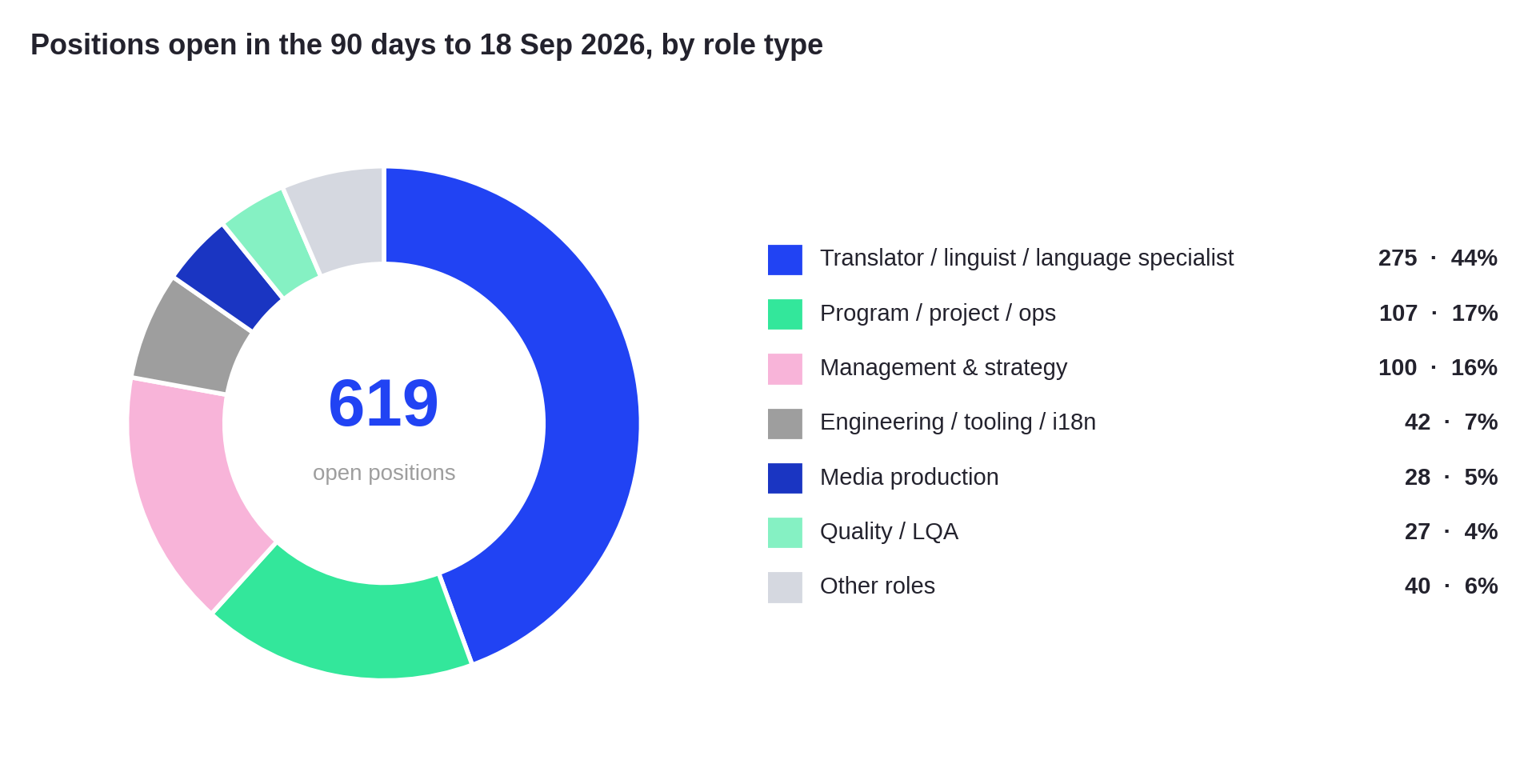
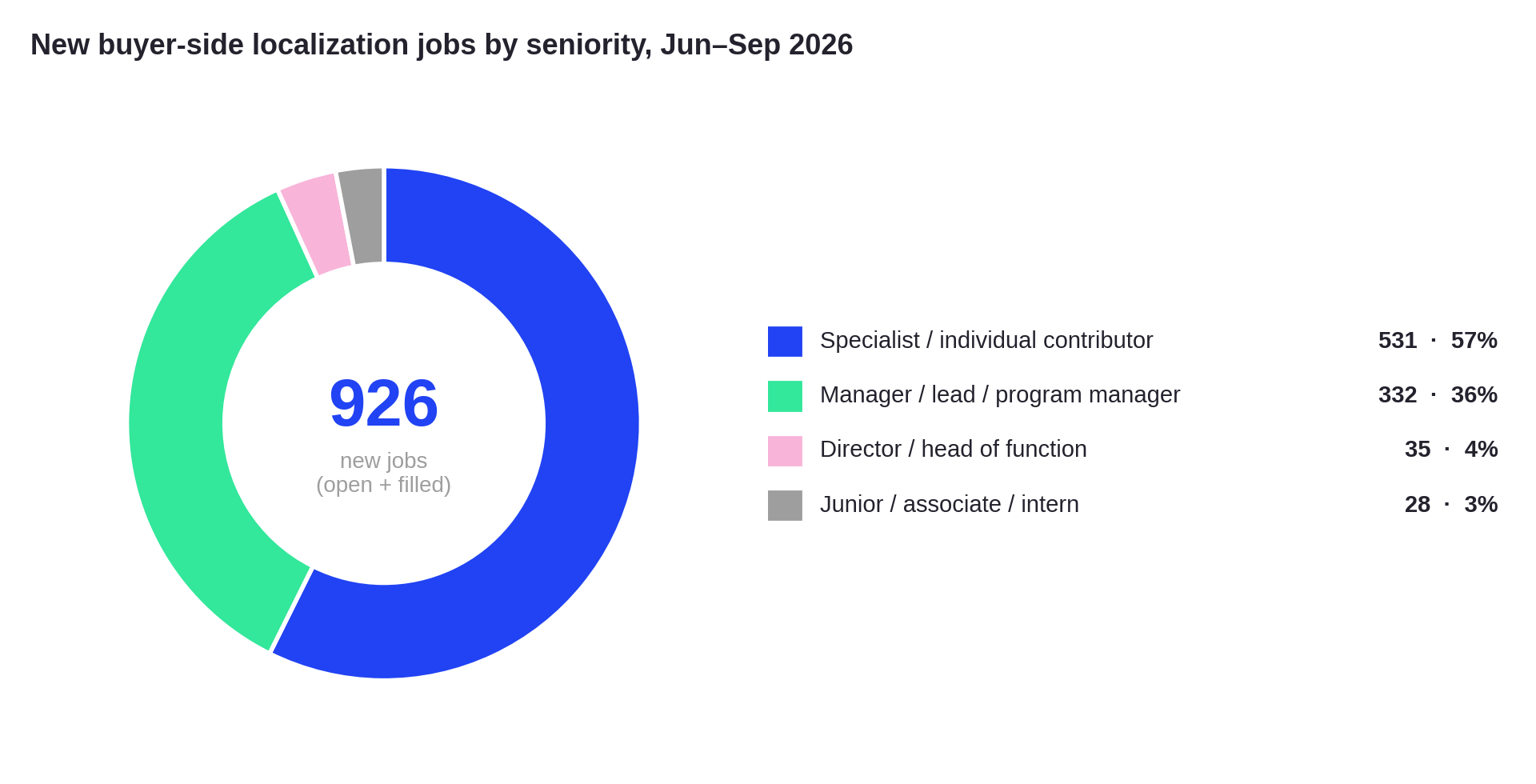
Translator, linguist and language-specialist titles are the largest single category we found: 332 of 927 records, or 36%. They also account for 275 of the 619 open positions, almost half of what is advertised. Employers are hiring people for language work.
The claim becomes more understandable when you look at particular employers. One of the 32 records for Netflix, Prime Video and Amazon MGM Studios is a translator role. Linguist titles are about one in five roles in media and in tech, and two in three at manufacturers. Someone watching streaming companies would see a very different market from someone watching game studios.
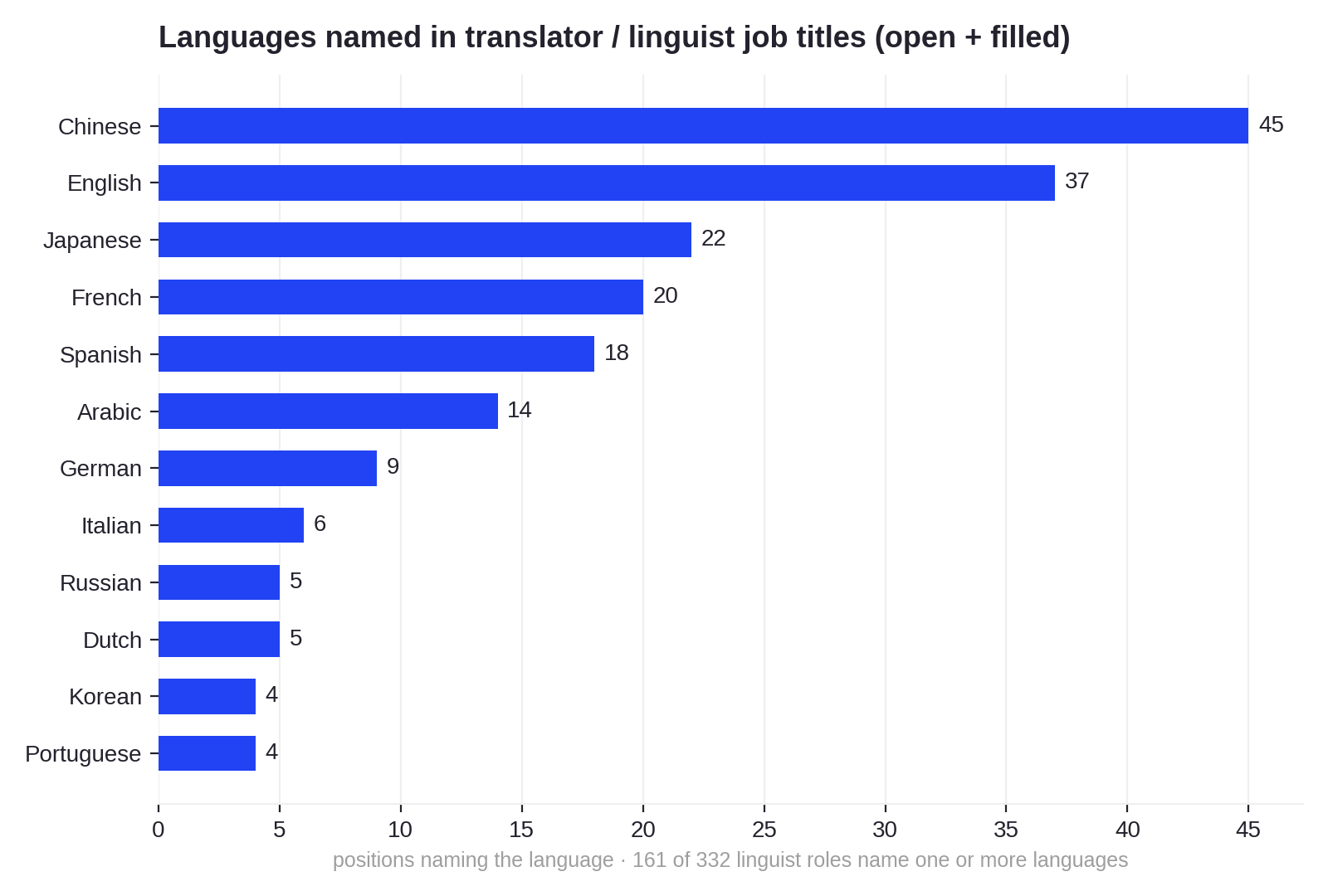
Language and geography help explain the difference. Among the 161 linguist titles that name a language, Chinese, English and Japanese are the most common, followed by French. Many Mandarin roles are at Chinese-owned manufacturers and traders with plants in Indonesia. Japanese-language roles include positions at Japanese-owned plants in the United States, IQVIA Language Solutions in Europe and Farfetch. English appears mostly as one half of a pair, Chinese-English, Japanese-English or English-Spanish, and on its own as native-English editors and specialists at studios and platforms whose source content isn’t English. French roles cluster in Canada, where banks, insurers and public bodies translate between English and French, and at European institutions.
A manufacturer hiring a linguist for a plant and a streaming company hiring localization producers have different needs. Treating one as evidence for the whole profession hides opportunities in the other. If you’re looking for in-house language work, the industry and language pair matter more than a general claim that translator hiring has stopped.
If you’re looking for in-house language work, the industry and language pair matter more than a general claim that translator hiring has stopped.
We’ve listed the 610 posted openings with employers, locations, workplace type and posting links in a downloadable spreadsheet. The nine roles announced in employee posts aren’t included, since their only links lead to personal profiles.
“AI is taking the jobs” confuses task automation with hiring
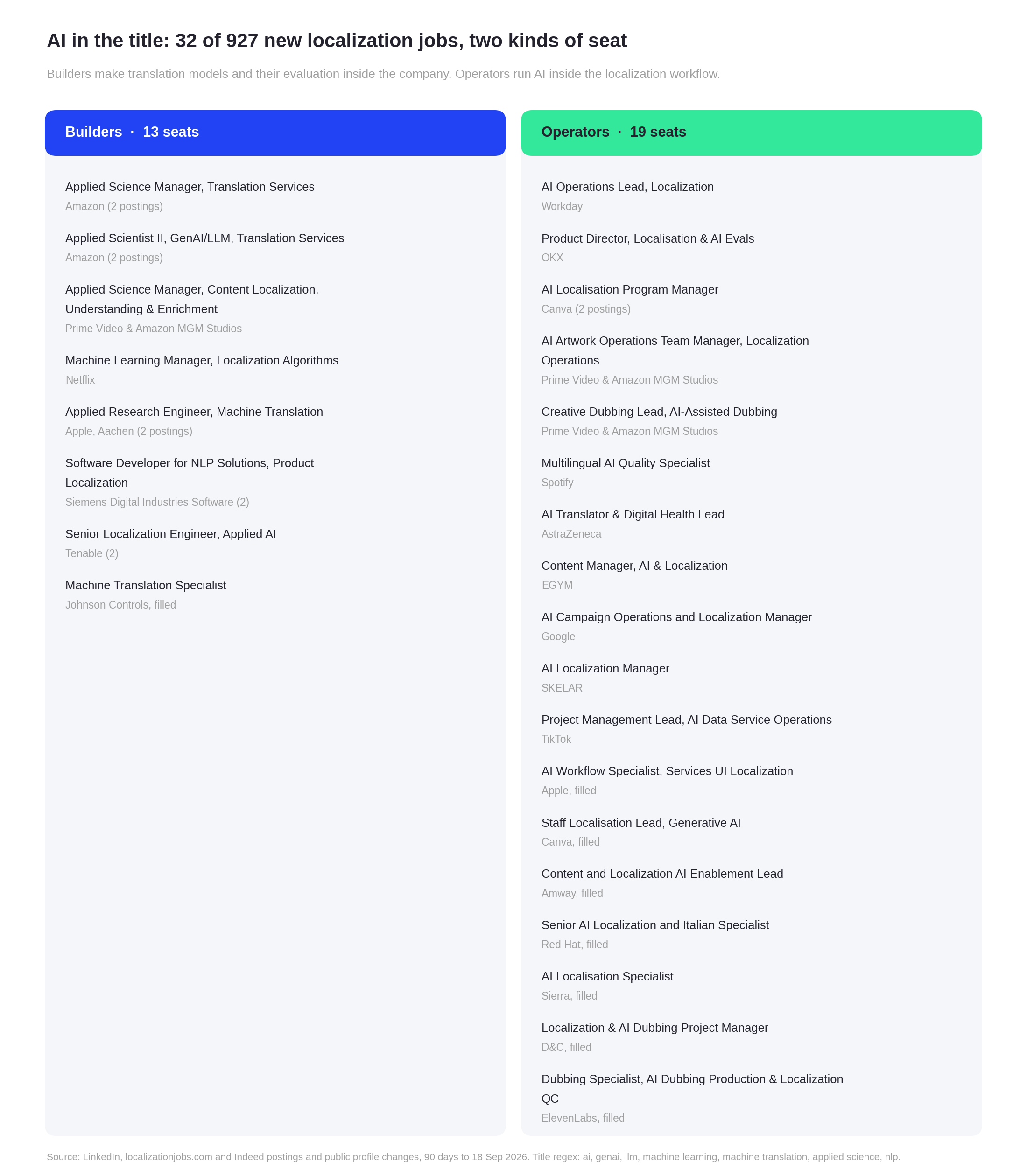
The continued demand for linguists doesn’t tell us how many jobs AI has displaced. Neither does counting AI titles. We classified 32 of the 927 records as AI-related, including machine translation and natural language processing (NLP), but many roles can involve AI without naming it.
What those titles do show is that adopting AI creates different kinds of work. Amazon advertises translation-science roles, Apple has two machine-translation research engineers open in Aachen, Siemens has NLP development positions, and Tenable is hiring localization engineers for Applied AI. These roles focus on developing technology. Workday’s AI Operations Lead for Localization and Spotify’s Multilingual AI Quality Specialist address a different need: managing how a team uses it. Recent appointments include AI Workflow Specialist and Content and Localization AI Enablement Lead titles as well.
In our earlier post, one task in six ran on AI end to end. That measures tasks, not jobs. The hiring evidence adds something useful: employers need people to build translation technology and people to manage its use. It doesn’t establish the net effect on employment.
For a localization leader considering an AI hire, that distinction matters. Developing a model and putting AI to work in a localization process require different responsibilities, and the job title should follow the need.
Developing a model and putting AI to work in a localization process require different responsibilities, and the job title should follow the need.
“AI companies will do it all with AI” isn’t what AI companies do
A stronger version of the claim comes from executives at AI-first companies, and from executives who feel AI-first because the company pays for GPT: with models this good, why hire localization people at all. The companies closest to the models answer that with their own postings.
OpenAI is advertising two seats in San Francisco, a Software Engineer, Localization and a Localization Manager. Anduril, whose products are AI-driven defense systems, is advertising a Director, Localization Programs in Washington, DC, a head-of-function seat with no departure behind it in the public record we collected. On the appointment side, two frontier AI labs and an AI-agent company filled five localization seats between them over the summer: four localization managers or program managers and one AI localization specialist, per public profiles.
What these companies hire is telling. None of the seats is a translator. They are an engineer, a director, managers and program managers, the layer that decides what gets localized, to what standard, and how the models are put to work on it. The organizations with the most AI in-house are staffing the coordination of localization, not skipping it.
For an executive planning to replace the localization function with a chat window, that is the comparison to make. The companies that build the models have hired people to run localization. A company that only subscribes to them is not more automated than they are.
The companies that build the models have hired people to run localization. A company that only subscribes to them is not more automated than they are.
“The localization manager is next” doesn’t fit current hiring
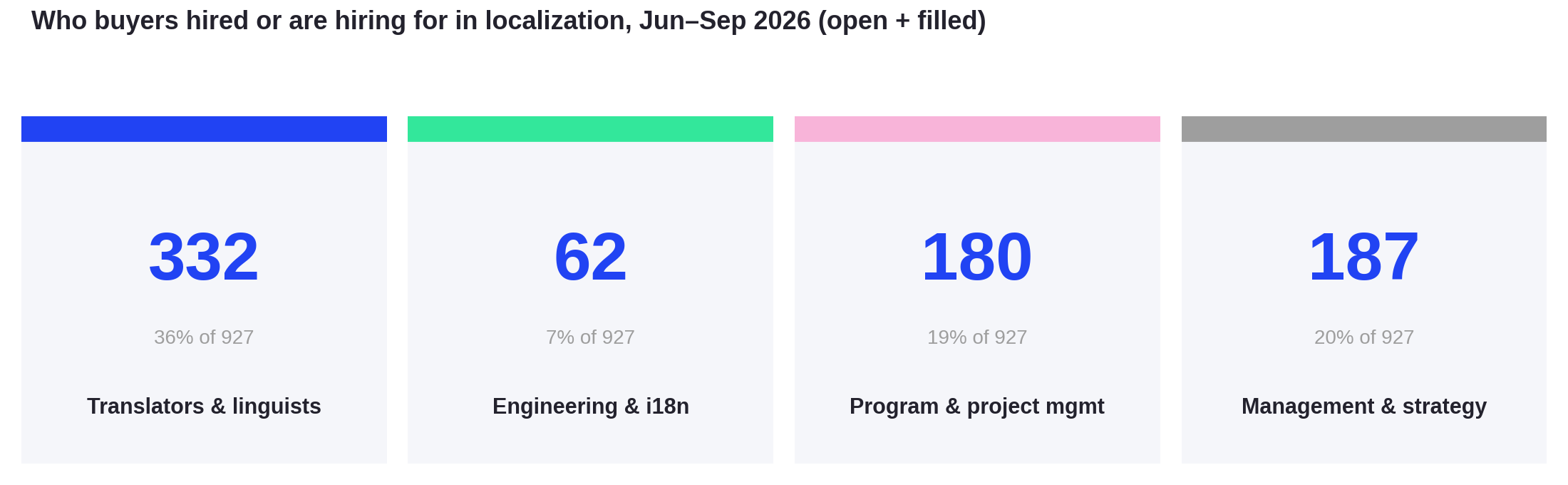
If employers no longer needed localization managers, management roles would be hard to find. Instead, management, strategy and program-management titles account for 367 records, compared with 332 translator and linguist titles. Employers hire people who coordinate the work and decide how it should run.
These aren’t mostly executive appointments. Specialist and manager-level titles account for 93% of all records, while Director and Head roles account for about 4%. Companies are staffing the people who do and manage the work day to day.
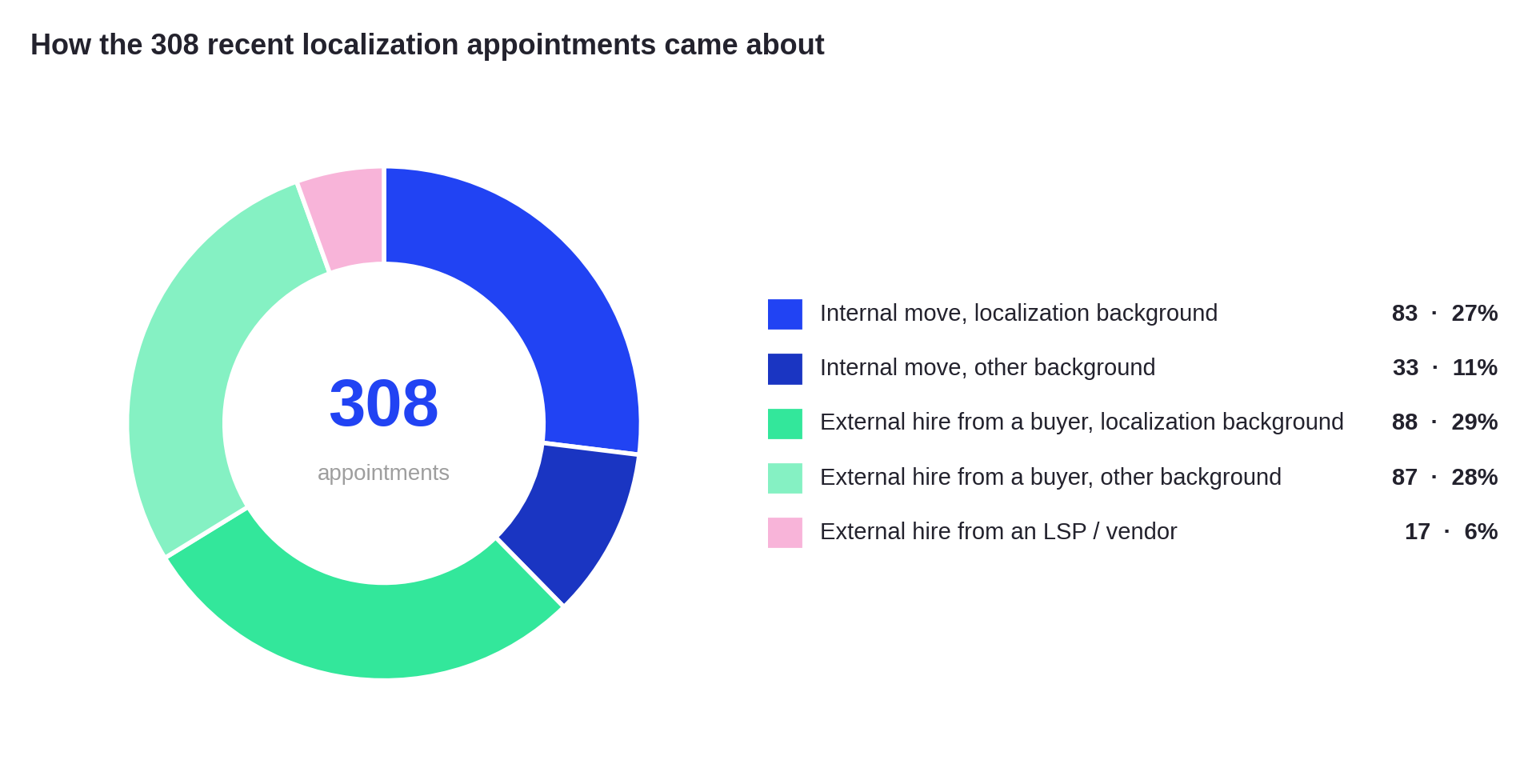
There is also a route to greater responsibility inside existing teams. Of the 308 appointments, 116 were internal moves. Forty-two of those moved up by title-based seniority, while 66 stayed at the same level. Internal candidates filled 11 of the 14 Director or Head appointments. That gives managers a reason to consider internal opportunities alongside an external search.
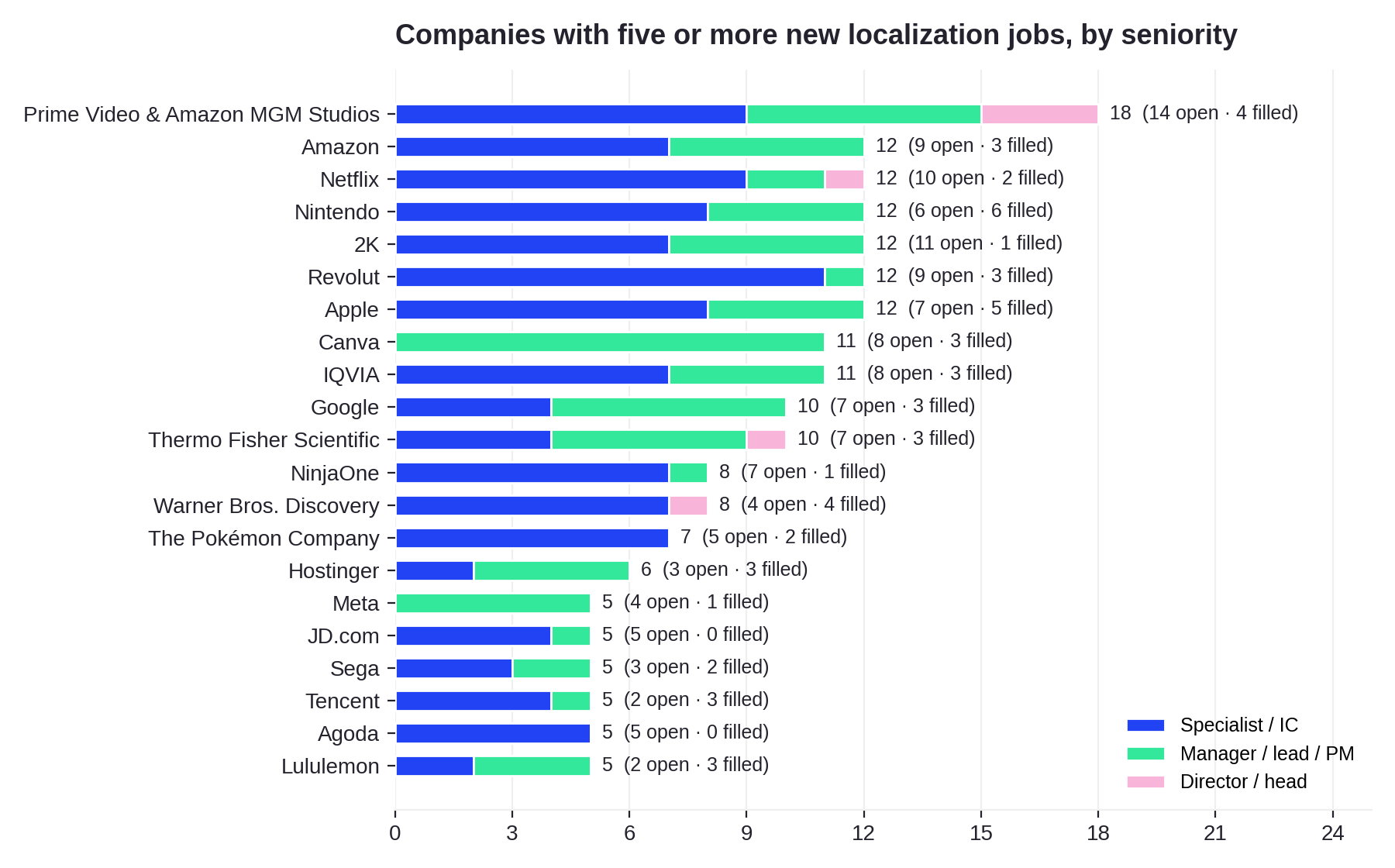
The work these managers coordinate varies by company. Prime Video and Amazon MGM Studios list producers, technical program managers and creative directors. Nintendo’s roles include engineering and production, while IQVIA and Revolut are hiring language specialists. Meta’s five records are program managers, and five of Google’s ten are Localization Product Strategists.
This connects to the distinction between execution and governance in our earlier post. As tools change how translation happens, someone still has to define acceptable quality, organize delivery and take responsibility for the result. The hiring records are consistent with demand for that work, though titles alone can’t show how each employer divides it.
Someone still has to define acceptable quality, organize delivery and take responsibility for the result.
“Quality and vendor management are the safe human jobs” needs a closer look
Management hiring is common, but two familiar specializations are rare under their own titles. Only three of the 927 records fall into vendor management: Hyundai Motor Company’s Manager of Localization Coordination and Procurement, Google’s Vendor Operations Manager for Localization and an Amazon Vendor Management Assistant in Hyderabad. Quality assurance, including linguistic quality assurance (LQA) and testing, accounts for 40 records, about one in twenty-three, and four in ten of those sit at game studios.
That is a narrow set of opportunities for someone searching only for Vendor Manager or LQA Specialist. It also complicates the idea that these are the obvious careers to move into as translation becomes more automated.
The responsibilities may remain even when employers don’t advertise dedicated positions. A program manager may select suppliers, and an operations lead or localization engineer may own quality checks. The evidence here is about the scarcity of dedicated titles, not the disappearance of the work.
For someone with vendor-management or quality experience, the practical response is to search for those responsibilities within broader roles. Program management, operations and localization engineering are worth examining alongside the familiar titles.
For someone with vendor-management or quality experience, the practical response is to search for those responsibilities within broader roles.
“You need a localization background to get in” is too restrictive
For 130 of the 308 appointees, the recorded previous title contained no localization or language term. Marketing, content and communications account for 34 of those previous roles, and program, project and operations management for 29. Employers are hiring across functional boundaries.
These hires generally didn’t start at junior level. Most arrived as specialists or managers, and only two held junior titles. Experience in content or operations can be relevant enough for someone to move into localization without starting over.
Experience in content or operations can be relevant enough for someone to move into localization without starting over.
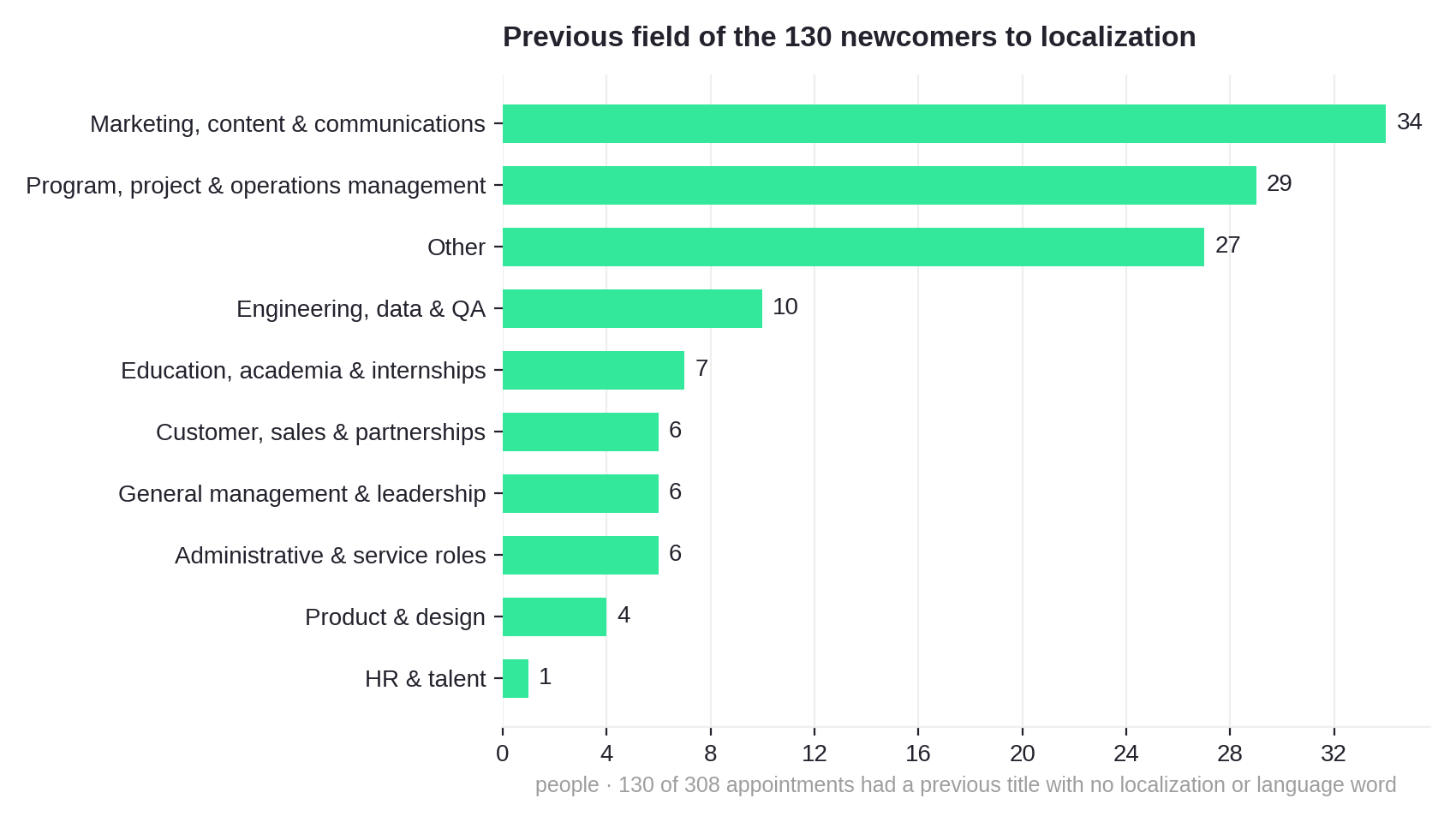
There is a limit to calling these people newcomers: we recorded one previous role per person, not a complete career history. Some may have worked in localization earlier or performed localization tasks under another title. Still, their appointments show that employers recruit people whose experience includes other functions.
The opposite claim, that outsiders are taking experienced practitioners’ jobs, goes beyond what these appointments show. We don’t know whom employers considered or why they chose a candidate, only that people with localization titles moved between companies, usually at the same seniority level. Moves from suppliers into in-house teams were also mostly lateral: 12 of 17 stayed at the same level.
For hiring managers, this supports considering relevant experience in marketing and operations. For experienced localization professionals, it suggests separating two goals that often get combined: changing employers and gaining seniority. Many external moves achieved the first, while internal appointments accounted for most Director and Head roles we observed.
“Learn to code or leave” overstates the engineering route
Engineering, tooling and internationalization account for 62 of the 927 records, roughly one in fifteen. Technical roles exist, but they represent a small part of the hiring we found. Openings include five Localization Web Developer positions at NinjaOne and three technical product-management positions for content platforms at Braze, and several other employers have one or two each.
Even those roles don’t draw exclusively from people with engineering titles. Of the 20 recent appointments in this category, ten followed an engineering role and five followed a program-management role. New titles include Localization Tech Lead and Localization Technology and Automation Lead.
We didn’t assess candidates’ skills, so this doesn’t show that coding is unnecessary. It does show that a previous engineering title isn’t the only route into technical localization work. Program-management experience can lead there too.
A previous engineering title isn’t the only route into technical localization work. Program-management experience can lead there too.
Technical skills expand a localization professional’s options. Treating software engineering as the only viable future ignores both the larger demand for language and management roles and the varied backgrounds of people entering technical positions.
A single job board gives a misleading picture of where the jobs are
The same caution applies to geography. On LinkedIn, North American postings outnumber European ones. On localizationjobs.com, European postings outnumber North American ones two to one, and most of the EU institutions, courts and central banks that hire translators appear only there. Indeed adds mostly Japan and India. Put the boards together and Europe has the largest share of open positions, 243 of 619, and the largest share of appointments, 160 of 308. Only 37 employers appear on both of the larger boards.
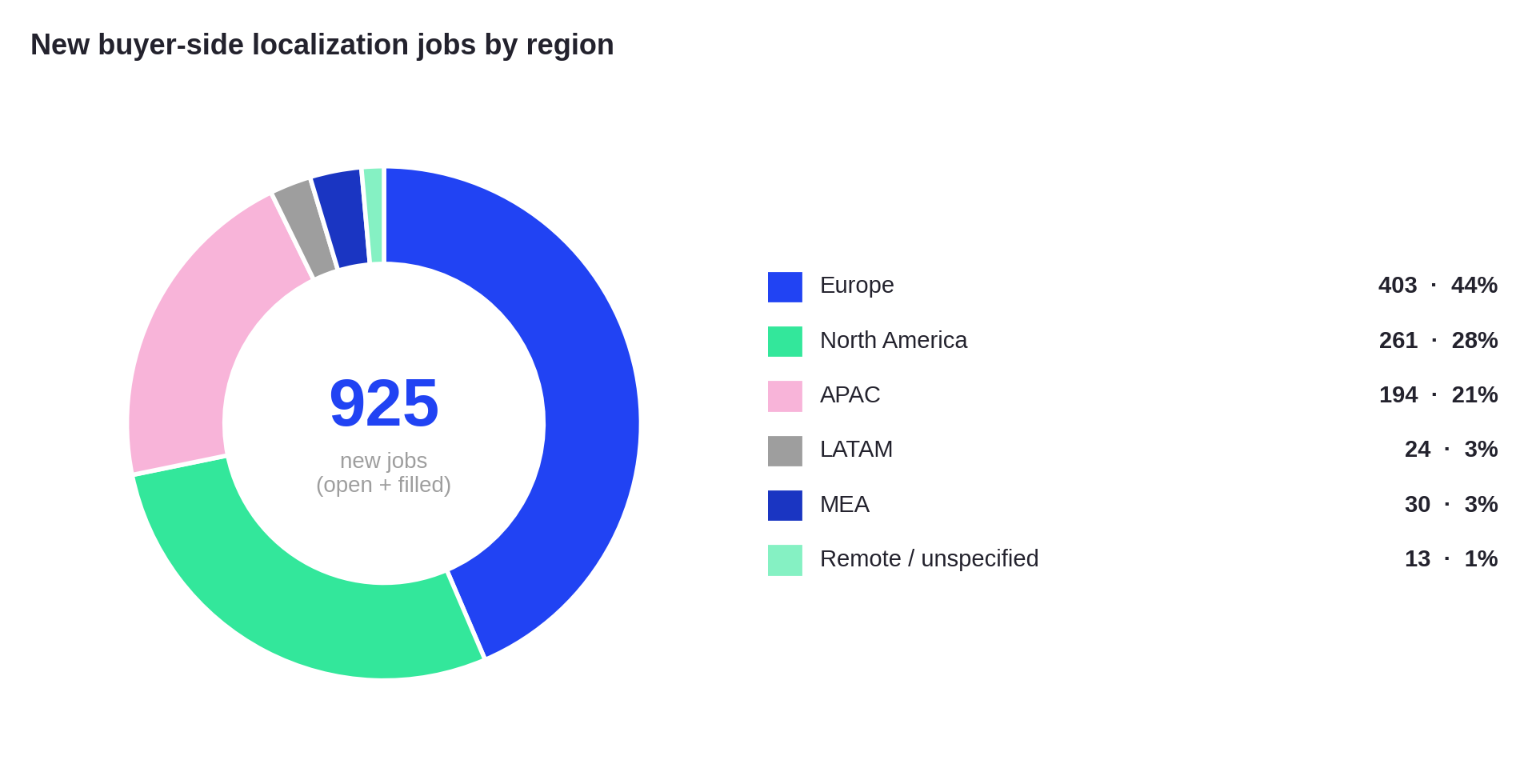
A job board shows the employers who use that board. Anyone reading the market from a single one, including LinkedIn, sees that board’s clientele rather than the market.
“Localization went remote” holds for one posting in four
Employers marked 378 of the 619 open positions as on-site, hybrid or remote. Almost half of those are on-site, three in ten hybrid and one in four remote. LinkedIn is the only board where every posting carries the field, and there remote is one in ten. localizationjobs.com has no such field, and the postings there that mention a working arrangement at all mention remote work more often than an office, so the combined remote share leans high.
Program and project managers have the most remote seats, four in ten. Half of the translator and linguist seats are on-site, and the remote ones concentrate in tech: Revolut alone accounts for nine of the 35 remote translator postings, with the manufacturers and game studios that hire in-house translators almost all on-site. Engineers work hybrid more often than any other group, in six postings out of ten.
Remote seats cluster in Europe: three postings in ten there are remote and four in ten hybrid. In North America one posting in five is remote, and in Asia-Pacific one in twenty. Specialists, managers and directors split in similar proportions, so the region says more about the arrangement than the level does.
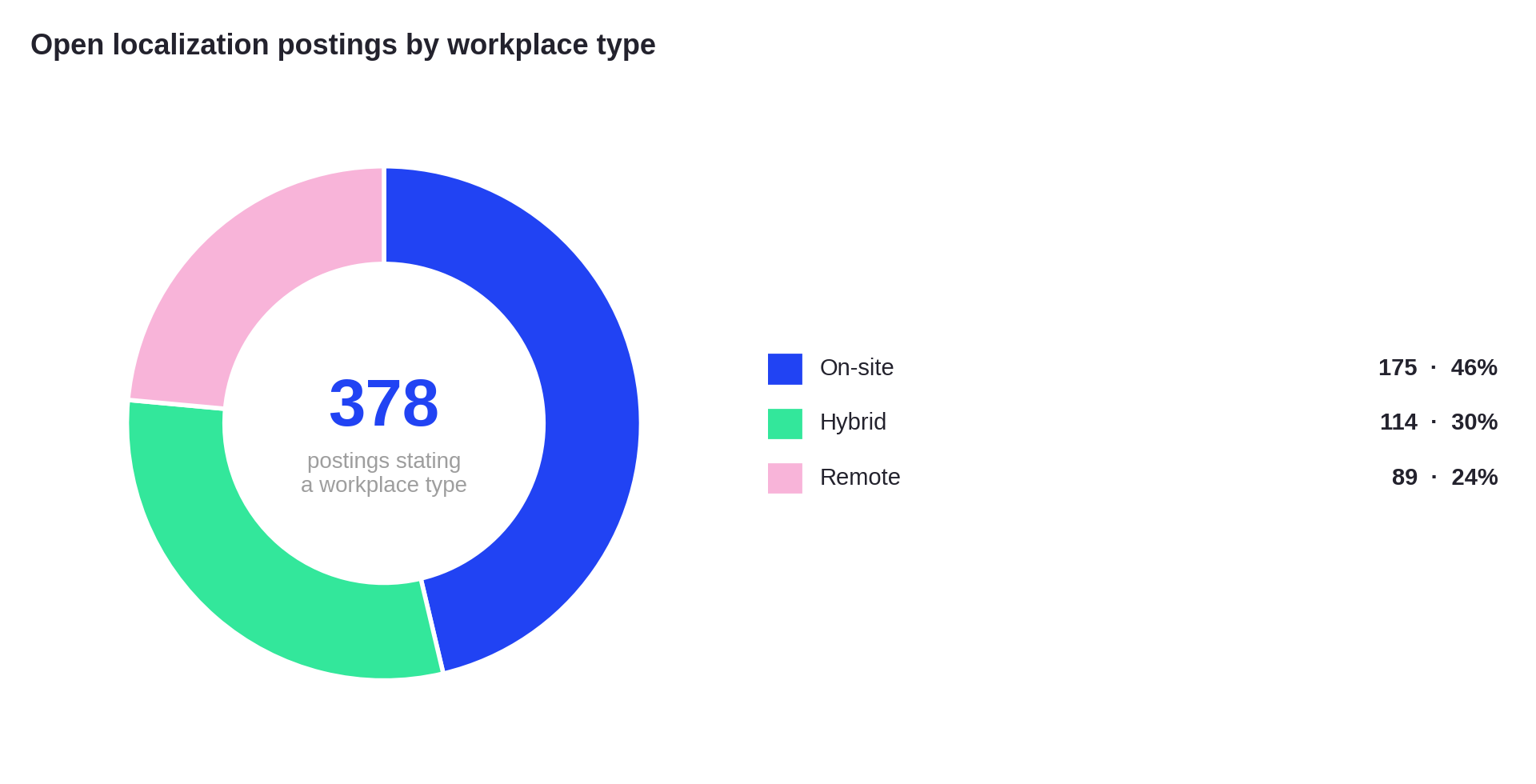
If you need remote work, program and project management is where the seats are, and in Europe a hybrid seat of any kind. If you’re a translator, one in-house posting in four is remote, and on LinkedIn one in twenty.
The work employers need is more specific than the claims
The broad claims about localization careers miss distinctions that matter to a job seeker. Linguist demand depends on industry and language. Management roles remain common, while dedicated vendor-management and quality titles are scarce. People arrive from other functions, and some program managers move into technical roles. The companies that build the models hire localization managers and engineers rather than doing without.
For a job seeker, the useful unit is the responsibility rather than the title, and the industry next door may be hiring when yours isn’t. For someone whose goal is promotion, the internal route filled most of the Director and Head seats we saw. For employers, the same findings argue for assessing relevant skills directly instead of requiring a particular previous title.
For a job seeker, the useful unit is the responsibility rather than the title, and the industry next door may be hiring when yours isn’t.
To explore the actual openings, download the spreadsheet with the 610 posted positions, including employers, locations, workplace type and links to the original postings. Some positions may have closed since 18 September.
Method and limitations
Window and sources. We examined hiring activity in the 90 days to 18 September 2026. Open positions come from three sources: LinkedIn job postings and employee hiring posts (260), localizationjobs.com (309 after removing postings already on LinkedIn) and Indeed country sites for the US, UK, Germany, France, Spain, Italy, the Netherlands, Poland, Ireland, Sweden, Japan, Singapore, Australia, India and Hong Kong (50 after the same check). We matched duplicates across sources on company and title. Appointment records came from Sales Navigator profiles with a start date in that period and stated tenure of four months or less.
Appointment selection. Searching by job title and recent job change returned 1,053 profiles. Of these, 899 were at companies hiring for in-house teams and 580 held language-industry titles. We transcribed 418 and retained 308 with both an in-house destination and a recorded previous role.
Scope. Buyer-side roles are positions in in-house teams. Company-name filters exclude language service providers, translation-technology vendors, staffing agencies, consultancies hiring for clients, defense linguist contractors and freelancers. Title rules remove unrelated uses of “localization,” “translation” and “internationalization,” interpreter roles (a different market, even when the title also says translator), and clerical or care roles with a translation duty. Both filters can incorrectly include or exclude records.
Classification. Function, seniority and industry tags use title patterns and company-name lists, rather than a review of responsibilities. We assigned no industry tag to 191 records.
Workplace type. LinkedIn carries an on-site, hybrid or remote field on 251 of its 260 postings. localizationjobs.com has no such field, so we took remote from the location line on 49 postings and read the arrangement from the description text on another 75 where it names one. Indeed carries the field on 3. A posting with nothing stated stays blank in the spreadsheet and outside the workplace figures, not counted as on-site.
Coverage. LinkedIn removes most postings after about 30 days, so its share of the sample favors August and September. localizationjobs.com keeps postings longer and is heavier on European and public-sector employers. Indeed’s title search returns few in-house localization roles outside Japan and India, and we capped its Japanese results at the most recent eight pages of about 150. The appointment sample excludes private profiles, profiles without a previous role and titles outside the search terms. The recorded previous role isn’t always the position immediately preceding the appointment. Region comes from the posting location, or the country site for Indeed, and can be approximate for remote roles. The sources aren’t a complete census of localization hiring.
Counting. We removed duplicate postings across the three job boards but did not deduplicate between postings and appointments. A position can therefore appear twice, and internal appointments don’t necessarily represent additional headcount.
Links and attribution. Postings may have closed, changed or been reposted since 18 September 2026. Named employer examples in the text refer to public postings, and we describe individual career moves without names. Open-position spreadsheet: Google Sheets.
