Intento Insights is one newsletter family with five streams, and you subscribe only to the ones you want.
AI What frontier-model releases, benchmarks and AI regulation mean for translation and localization.
Industry What is changing across the localization industry: market moves, research, and what practitioners are doing about them.
Localization job How the role itself is changing. What the job is made of, which parts AI takes, and how teams are restructuring around it.
Language Hub Product news and practical guides for running enterprise translation on Intento.
Case studies How named enterprise teams actually did it, what it cost, and what they would do differently.
Unchecking a stream stops that stream and nothing else.
What the job is actually made of
The Localization job stream is publishing one study right now. We went through all 38 LocWorld55 sessions in Dublin at once rather than session by session, and the 380 tasks people described on stage come apart into 43 distinct responsibilities.
Three of the 43 are translation execution: running it, post-editing it, handling multimedia. That is the part outsiders think the job is, and it is 7% of the map:
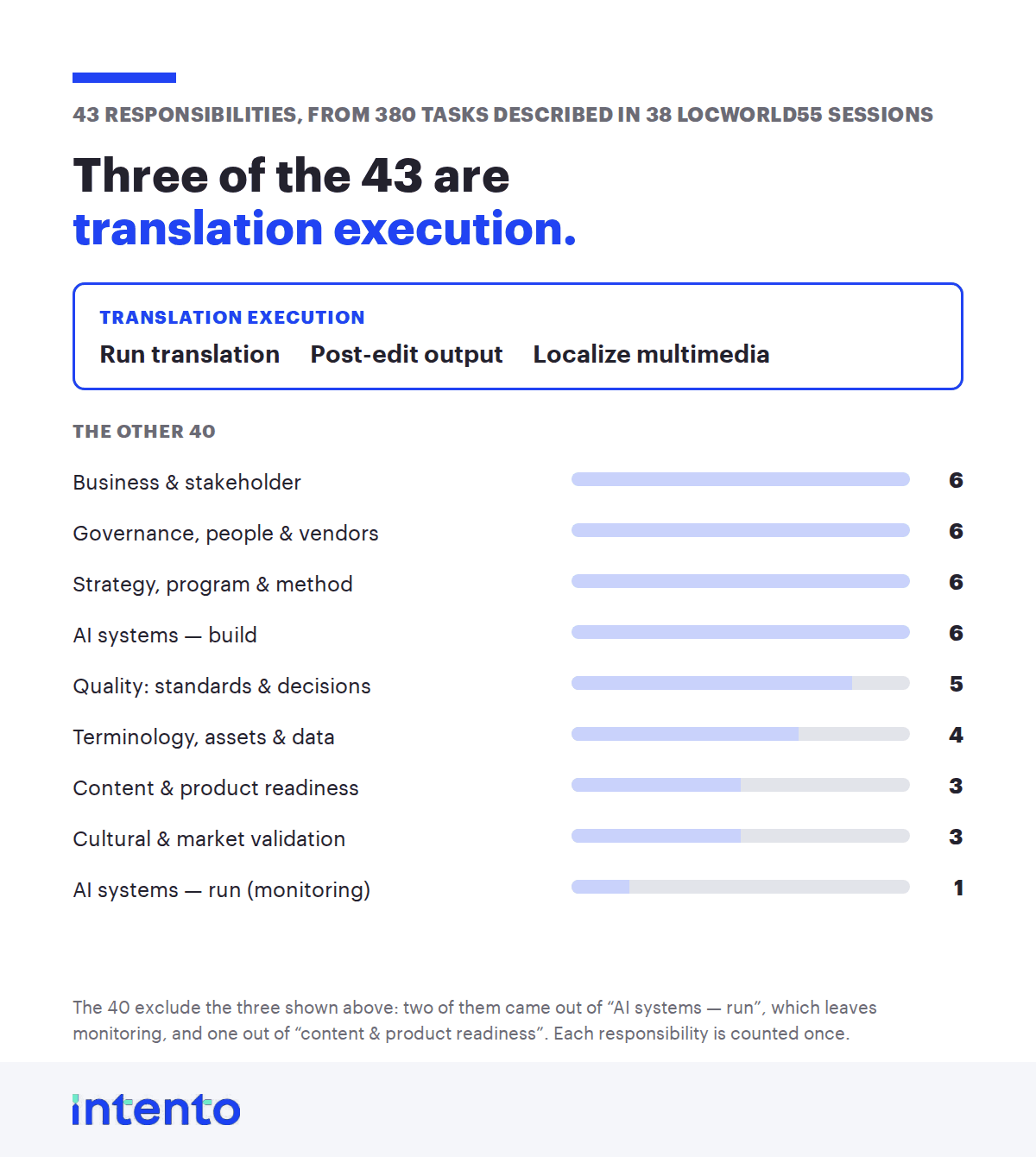
The other forty are things like defining the quality standard, deciding what ships, coordinating stakeholders, building terminology, screening for culture, repricing vendors, setting the language portfolio. Specific, unglamorous, and mostly not about translating anything.
Which is why “will AI replace the localization manager” can’t be answered as put. Taken one responsibility at a time it has 43 answers, and a defense of the job built on translation quality is defending three of them.
The week runs in loops, not tasks
A responsibility is something someone owns. A loop is a circuit that keeps coming back: a signal arrives, someone triages it, a fix ships, and the fix changes the next signal. Across those same 38 sessions there are 107 of them, by the names people gave them on stage:
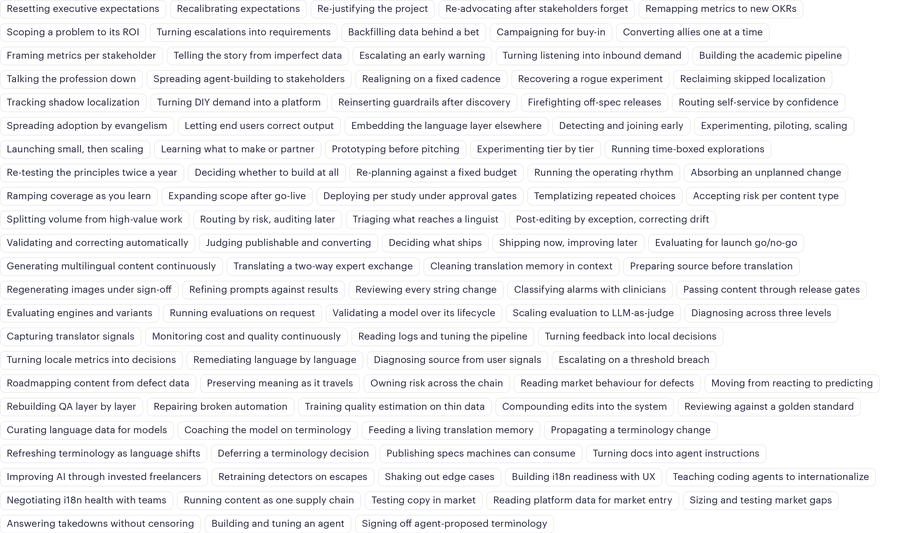
Take refreshing terminology as language shifts. The language moves, faster now with social platforms pushing it, the termbase goes stale, someone notices, it gets updated, and the clock restarts. Nova Patch, Director of Internationalization & Localization at Shutterstock, described it at LocWorld55: “It’s actually hard to stay on top of all of this.” No job description contains that loop, and for somebody it is a standing part of the week.
And half of them aren’t about content at all
Sorted into families, the 107 split almost exactly down the middle:
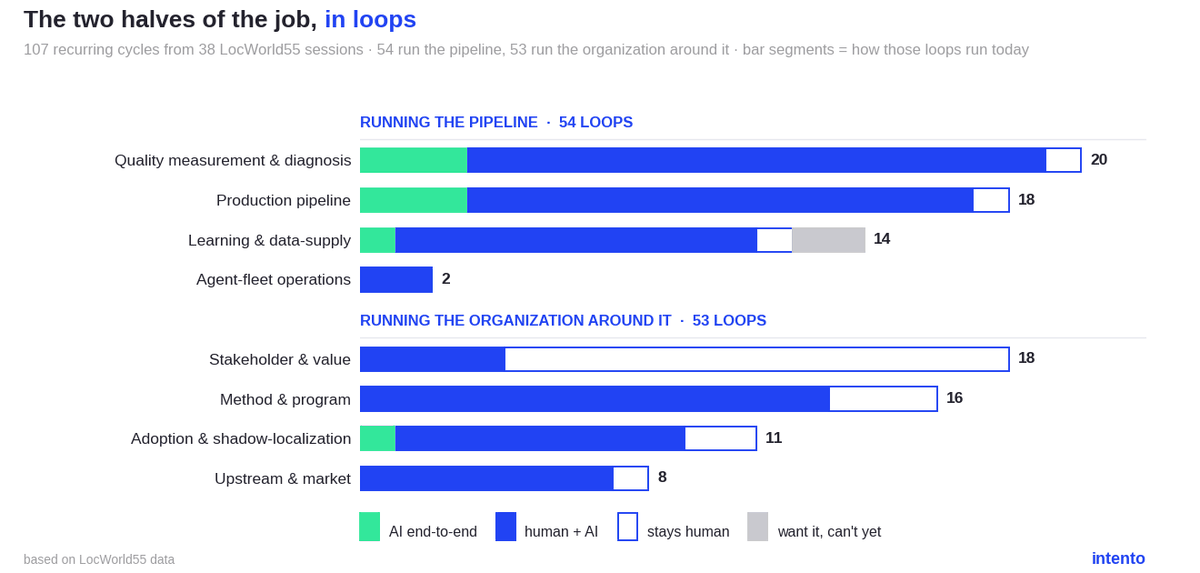
54 produce content. The other 53 run the organization around it: the humans, the budget, the mandate, and the teams who went around localization and did it themselves.
The two halves are not moving at the same speed. Of the 22 responsibilities in the pipeline half, 15 have an AI-end-to-end reading somewhere in this data. Of the 21 in the organization half, one does. The argument about AI is aimed at the half that is already automating.
Everything from this study lands in Localization job.