Sent to the Industry stream of Intento Insights on 30 October 2026. The stream covers what is changing across the localization industry.
Translation teams will update EU product instructions for years after launch
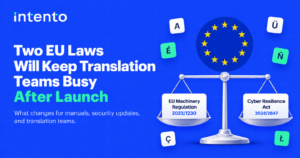
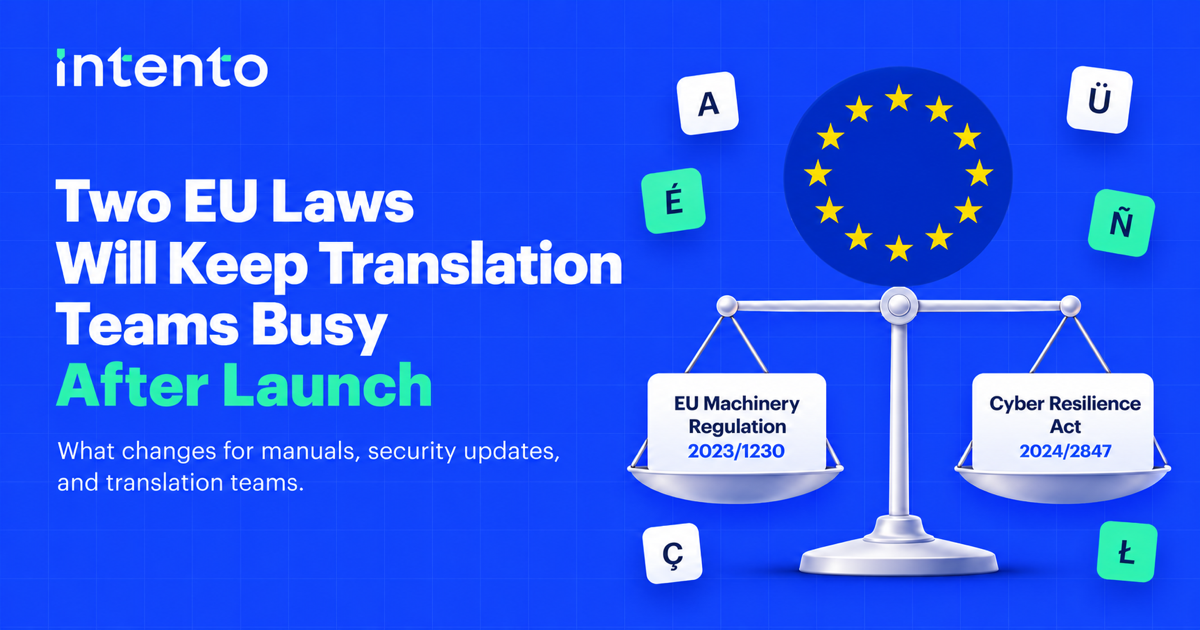
Two EU product laws apply in 2027, the Machinery Regulation from 20 January and the Cyber Resilience Act from 11 December. Translation barely appears in either text, yet under both, manufacturers can’t sell a product in an EU country without instructions in the language that country requires, and translation teams keep updating those instructions for years after launch.
Until now, manufacturers had to ship every machine with instructions in the official language of each EU country where they sold it. Under the Machinery Regulation, they still have to provide instructions in a language users in each country can easily understand, and if they publish them online, they have to keep them available, downloadable and printable for the expected lifetime of the machine and at least 10 years after they put it on the market. The same rule applies to instructions built into the machine software.
Under the Cyber Resilience Act, manufacturers of connected products also have to include security guidance in the instructions, such as who to contact about a vulnerability, how to install security updates and when support ends, in a language users can easily understand, and keep it available for at least 10 years or until support ends if that’s longer. The CRA has no separate language rule for notices about severe incidents, but users can only act on advice they can read.
If you run localization for machinery or connected products, you’ll translate every revision of the instructions into each required language for 10 years or more, along with security guidance, support dates and vulnerability contact pages. Engineering and cybersecurity teams with little experience in translation may write some of it, and users need security notices in their language before the next manual release. One connected machine can also fall under both laws, so you’ll need one glossary that keeps safety and security terms apart in every language.
We looked into both laws together with a customer that makes industrial automation equipment and software. In the blog post, we work through an example of a vulnerability fix for a controller sold in 12 EU countries and list five steps to take before 2027, from working out which products and languages each law covers to deciding where a person needs to review the translation. We also note that under the CRA, a manufacturer that adds a language to a product interface shouldn’t normally have to reassess whether the product meets the rules.